
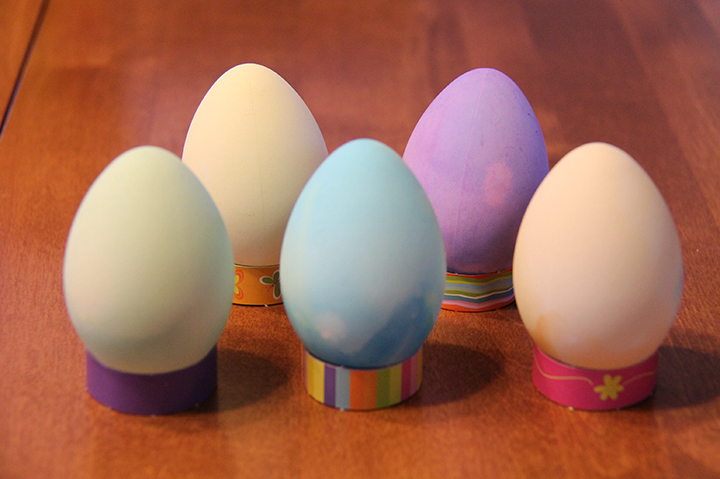
At a very young age, my daughter Savannah was diagnosed with life-threatening allergies to eggs, milk and peanuts, which has forced us to make adjustments when we celebrate Easter. We make our own bunny chocolates with dairy-free, nut-free chocolate and store-bought Easter molds. We buy Surf Sweets jelly beans and other allergen-free Easter candies. We bake and decorate Easter cookies. We haven’t decorated Easter eggs…until now.
This year for Easter, as we celebrate the Resurrection of Jesus, we dye eggs.
First, a little background. I did some internet research, because I wondered why we decorate eggs in the first place. According to History.com, “The egg, an ancient symbol of new life, has been associated with pagan festivals celebrating spring. From a Christian perspective, Easter eggs are said to represent Jesus’ emergence from the tomb and resurrection. Decorating eggs for Easter is a tradition that dates back to at least the 13th century, according to some sources. One explanation for this custom is that eggs were formerly a forbidden food during the Lenten season, so people would paint and decorate them to mark the end of the period of penance and fasting, then eat them on Easter as a celebration.”
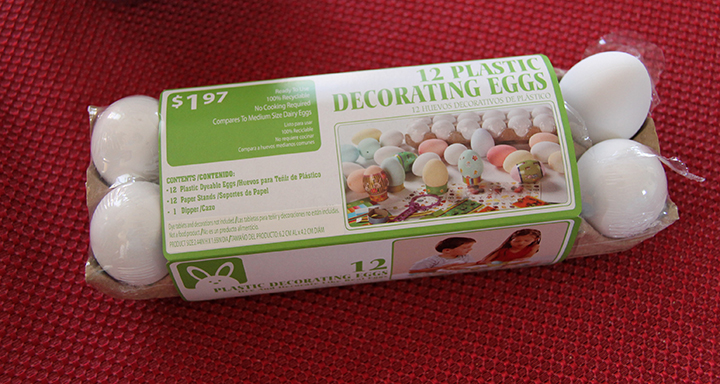 So now you know why. Let’s talk about how. I recently bought “12 Plastic Decorating Eggs” from Wal-Mart, for $1.97. They do not open like the shiny plastic eggs used for Easter egg hunts. They look like real eggs. They are lightweight, hollow and have a white shell that is porous and easily dyed. The kit comes with a tray, egg dipper and paper stands. The dye is NOT included.
 For the dye, we used a PAAS Color Cups kit from Target. The only other ingredient we used was white vinegar, as the “Decorating Eggs” instructions recommended NOT using water.
Overall, this was a fun project. A few observations:
- We used 1/8 cup (2 Tablespoons) white vinegar in each cup, and I think that was the perfect amount. You wouldn’t want to use too much liquid in the cups because the hollow eggs would float to the top when dyeing.
- Instead of the dippers that came with the kits, we used wooden popsicle sticks to help turn and coat the eggs.
- The pink PAAS dye was not very vibrant (a problem seemingly more with the dye kit than the eggs), so we added a few drops of red food coloring from our pantry.
- I think that other coloring methods would also work well on these eggs, such as markers, food coloring, or glitter kits.
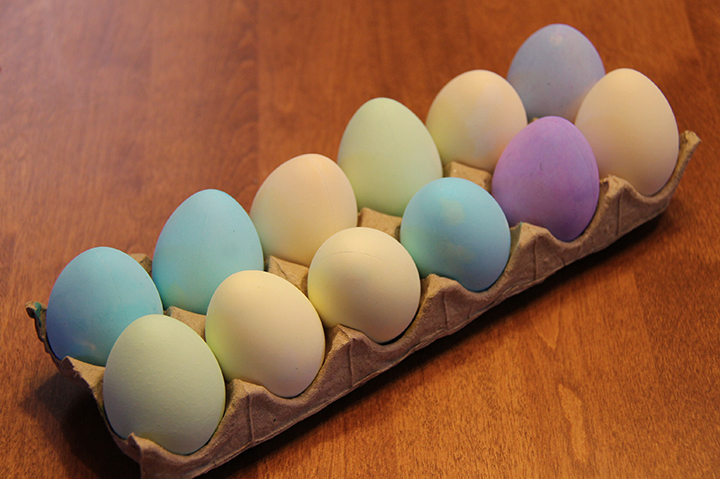 For a long time I thought Savannah would never have the opportunity to dye Easter eggs. These Plastic Decorating Eggs were fun, inexpensive, and a great alternative to the real thing.
In advance, I wish everyone a happy and blessed Easter!
Praise be to the God and Father of our Lord Jesus Christ! In his great mercy he has given us new birth into a living hope through the resurrection of Jesus Christ from the dead. — 1 Peter 1:3


 Allergy friendly. cupcake happy!
Leave a reply to Tracy Cancel reply